


Table of Contents
HIPAA compliant texting means using a secure messaging platform that protects Protected Health Information (PHI) through end-to-end encryption, user authentication, and audit trails. Standard SMS doesn’t encrypt data, doesn’t restrict access, and doesn’t create the audit logs federal law requires. A purpose-built platform does all three.
The case for texting in healthcare is straightforward:
- 70% of customers say SMS is the best way for businesses to get their attention
- 90% of texts are opened within 3 minutes
- 54% report missing notifications when businesses communicate through channels other than SMS
That reach comes with a compliance requirement the moment any message touches patient data. This article covers what HIPAA compliant texting requires, when standard SMS is acceptable, and which platforms to use for PHI and non-PHI healthcare outreach.
What Is Secure Text Messaging for Healthcare (and Who Needs It?)
HIPAA compliant texting means using a messaging platform that protects patient data at every step. Your team still gets the speed and convenience of SMS.
At minimum, a compliant platform needs three things:
- End-to-end encryption: messages are unreadable to anyone without the decryption key
- Access controls: only authorized staff can view patient conversations
- Audit trails: a log of every message sent, received, and read
Any organization that handles Protected Health Information (PHI) is subject to HIPAA requirements. PHI covers any data about a person’s health status, care, or payment for care. That includes hospitals, private practices, insurance companies, and the third-party vendors they work with. Standard SMS meets none of these requirements. A HIPAA-compliant messaging platform meets all of them.
What is HIPAA Compliant Texting?
HIPAA-compliant texting means using secure messaging apps to protect electronically protected health information (ePHI) shared between authorized users. Any organization handling Protected Health Information (PHI) must have physical, network, and process security measures in place.
These organizations include:
- Covered entities (CE): healthcare providers, insurance companies, private practices
- Business associates (BA): third-party billing, cloud service providers, software vendors
When a text message contains PHI, encryption alone is not enough. Federal law also requires a signed Business Associate Agreement (BAA) with any vendor whose platform sends, stores, or processes that PHI. A BAA is a legal contract that defines each party’s data protection responsibilities. Without one, sharing PHI with a vendor is a HIPAA violation, no matter how secure the channel is.
What counts as PHI in a text message?
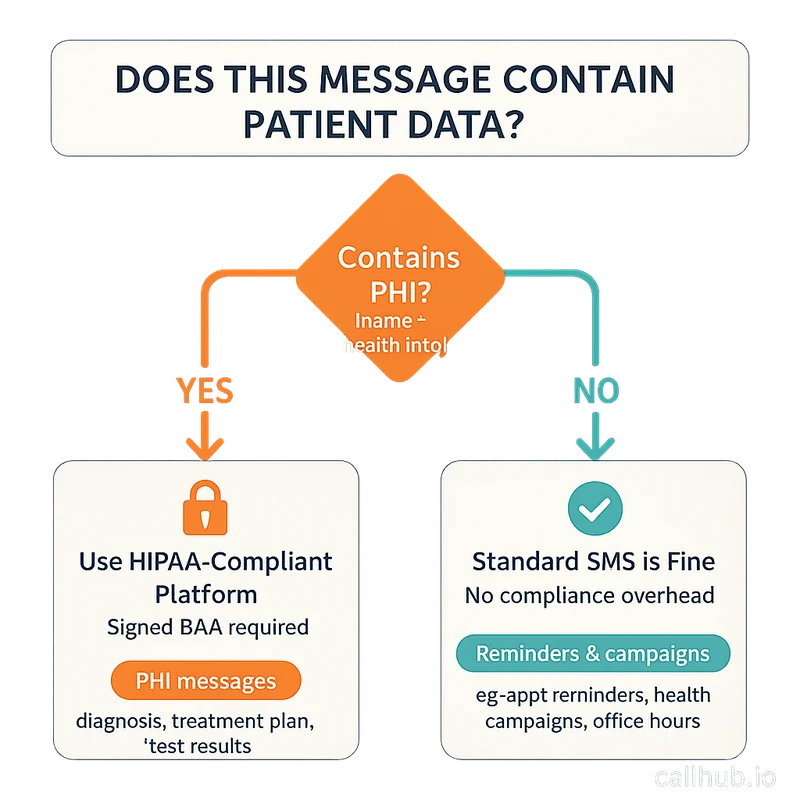
PHI is any information that links a person’s identity to their health status, care, or payment for care. In a text message, this includes combinations like a patient’s name paired with a diagnosis, an appointment date with a medical condition, or a date of birth alongside a treatment plan. De-identified information (where all 18 HIPAA identifiers are removed) does not qualify as PHI and can be sent via standard SMS.
Do you need a Business Associate Agreement (BAA) for HIPAA texting?
Yes. Any vendor whose platform sends, receives, or stores text messages containing PHI is a Business Associate under HIPAA. Before PHI passes through their system, you need a signed Business Associate Agreement (BAA) in place.
A BAA is a legal contract between your organization (a Covered Entity) and the vendor (a Business Associate). It defines:
- What PHI the vendor can access and why
- How they must protect that information
- Their obligations if a breach occurs
- What they can and cannot do with the data
Without a signed BAA, you are in violation of HIPAA from the moment PHI touches that vendor’s platform, even if the message is encrypted end-to-end.
How to verify your BAA before going live:
- Ask the vendor directly whether they sign a BAA before you evaluate their platform for PHI use.
- Get it in writing. A verbal agreement is not a BAA.
- Confirm both parties have signed. An unsigned template does not fulfill the requirement.
- Keep a copy on file. The HHS Office for Civil Rights (OCR) can request it during an audit.
Standard consumer tools, including WhatsApp, iMessage, and plain SMS, do not sign BAAs and are not suitable for PHI under any circumstances.
CallHub signs a BAA with organizations that handle PHI as part of their outreach. Learn more about HIPAA-compliant outreach with CallHub.
Secure text messaging vs standard SMS
| Aspect | Standard SMS texting | Secure text messaging for healthcare |
|---|---|---|
| Encryption | Typically none end-to-end | End-to-end encryption in transit and at rest |
| Access controls | Anyone with a device/SIM can read messages | Role-based access, authentication, often MFA |
| Audit trails | Very limited or none | Detailed logs of who sent, received, read, and when |
| BAA with vendor | Rare | Required for HIPAA-covered PHI use |
| Remote wipe / device loss | Dependent on MDM, often absent | Built-in or integrated remote wipe and lockout |
| Use with PHI | Not suitable on its own | Designed specifically for ePHI workflows |
Even popular collaboration tools aren’t safe for PHI unless configured for compliance and backed by a BAA. Secure texting for healthcare platforms are built for this from day one. That’s why a HIPAA compliant messaging app is now a core part of clinical communication.
When regular SMS is fine (and when it isn’t)
You can use standard SMS for some healthcare messages, as long as PHI isn’t included or is fully de-identified. In 2026, many clinics use secure messaging for PHI and standard SMS tools like CallHub for non-sensitive outreach.
Common cases where HIPAA texting rules don’t apply:
- Internal SMS between staff with no patient info
- General clinic updates or hours
- Messages asking patients to call or log into a secure portal
- Appointment reminders without diagnosis or treatment details
If there’s any risk of including identifiers plus health context, switch to secure text messaging for healthcare or route patients to a secure channel.
HIPAA compliance guidelines you need to follow
There are three main HIPAA rules to know:
- Privacy rule
- Security rule
- Breach notification rule
HIPAA Privacy Rule for healthcare texting
The Privacy Rule governs how organizations use and disclose health information, and gives patients rights over their own data. Covered information includes payment data for care, details of care provided, and mental or physical health status.
The rule does not apply to fully de-identified data, where all 18 HIPAA identifiers have been removed. That distinction determines whether a text message needs to go through a secure platform or whether standard SMS is acceptable for the specific communication.
HIPAA Security Rule: the three safeguard categories
The Security Rule sets protections for electronic PHI (ePHI) across three areas: administrative, technical, and physical.
Administrative safeguards cover the policies and people behind your compliance program: designating a security officer, running a formal risk assessment, restricting ePHI access to staff who need it for their role, and training the entire workforce on PHI handling rules.
Technical safeguards govern the systems that handle ePHI. Every user needs a unique login (no shared credentials). Messages and records must be encrypted both in transit and at rest. Your platform must log who accessed what and when, and you need a way to securely destroy ePHI when a device is wiped or decommissioned.
Physical safeguards are easy to overlook: controlling who can physically reach the servers and workstations where ePHI lives, and tracking the devices and media that store it.
For an organization using texting tools, technical safeguards are the most visible. But administrative safeguards (training, risk assessments, BAA documentation) have to be in place before you send the first PHI-containing message.
HIPAA Breach Notification Rule
If PHI is accessed or disclosed without authorization, your organization must notify:
- Individuals affected (by mail or email)
- The HHS Secretary (via the online breach portal)
- The media, if the breach affects more than 500 people in a single state or jurisdiction
A breach is any unauthorized use or disclosure of PHI. The rule has one important safe harbor: if the data was encrypted at the time of the breach and the encryption key was not also compromised, notification is not required. This is a core reason why encryption is non-negotiable in a compliant texting setup.
How to implement secure texting: A 3-step checklist
Technology is only part of the story. Policies and training matter too. Here’s a simple rollout path:
- Define your messaging policies
- Document what counts as PHI and set rules for what can’t be sent via SMS.
- Decide when to use secure texting for healthcare vs standard SMS, email, or calls.
- Select a secure messaging solution (and pair with CallHub for non-PHI outreach)
- Use CallHub for text messaging for healthcare outreach that doesn’t involve PHI: appointment reminders, health awareness campaigns, community updates.
- Use a HIPAA-compliant messaging app for any conversation that includes PHI.
- Confirm your vendor provides a BAA before committing to either platform for PHI use.
- Train, monitor, and improve
- Monitor audit logs and review messages to confirm compliance.
- Train staff on consent, PHI boundaries, and the secure use of the app.
Following these steps lets you run compliant healthcare outreach at scale without legal risk.
HIPAA-compliant texting apps
1. Blaze
Blaze is a no-code platform for building custom HIPAA-compliant messaging and workflows. It enables healthcare teams to create secure intake forms, internal chat, and patient messaging that integrate with existing databases and EHR systems, making it ideal for organizations with unique processes.
Pricing starts at $1,350 for the Internal plan, with Custom pricing available on request.
2. CallHub
CallHub is a HIPAA-compliant outreach platform built for nonprofits, unions, and political organizations that need to communicate at scale without compromising on data protection. Whether you’re running a health advocacy campaign, coordinating during a union strike, or collecting supporter stories that touch on personal health information, CallHub’s platform is built to handle sensitive data responsibly.
CallHub’s compliance infrastructure includes end-to-end data encryption, strict access controls, regular risk assessments, and ongoing policy reviews, so the people behind your data are protected at every step.
Pricing: Offers two plans, essential and scale. Mainly, it’s 0.19 per text. For more details, visit the pricing page.
3. TigerConnect
TigerConnect is a clinical collaboration platform built for hospitals and large provider groups that combines secure messaging, voice, video, and alerting in a single system. It supports on-call routing, escalation workflows, and EHR integration, enabling care teams to coordinate in real time.
Pricing: Available on request.
Best for: Organizations that need real-time coordination across care teams and deep integration with clinical systems and alerts.
4. Spruce Health
Spruce Health is a unified communication platform that combines secure messaging, telehealth, phone, and fax in one system. It lets patients securely send messages, photos, and forms, while staff manage conversations and follow-ups from a shared inbox.
Pricing: Basic plan at $24 and Communicator plan at $49.
5. Paubox
Paubox provides HIPAA-compliant email that sends encrypted messages directly to patients’ regular inboxes, with no portals or passwords required.
Pricing: Volume-based pricing. Contact Paubox for current rates.
6. Luma Health
Luma Health is a patient communication and engagement platform with secure texting for healthcare, designed to integrate with your EHR. It routes PHI into a secure chat environment, verifies patient identity, and logs all conversations in a centralized collaboration hub.
Pricing: Available on request.
Always match your organization’s needs with what each HIPAA-compliant messaging app offers.
Example: Policy snippet you can adapt
“Staff must not send PHI via standard SMS. Any message with patient identifiers plus health information (diagnosis, treatment, or similar details) must go through the approved secure messaging application. For appointment reminders, staff may use CallHub’s SMS tools but must not reference specific conditions, medications, or sensitive services.”
Expand this into a full policy with sections on consent, retention, device security, and breach escalation.
Sample patient reminder text (non-PHI, TCPA-aware)
“Hi [First name], this is [Practice name]. You have an appointment on [Date] at [Time]. Reply C to confirm or call [Number] to reschedule. Msg & data rates may apply. Reply STOP to opt out.”
This keeps health details out of the message and leaves clinical info for secure channels.
Send healthcare texts that are compliant by design
HIPAA-compliant texting comes down to two requirements: a platform that encrypts PHI and a signed Business Associate Agreement with that vendor. Both are now standard in purpose-built healthcare messaging tools.
For outreach that doesn’t involve PHI (appointment reminders, health campaigns, community updates), standard SMS with a platform like CallHub gives you the reach and automation you need, without the compliance overhead of a PHI-rated tool.
Know your PHI boundary, sign your BAAs, and train your team. Compliant outreach at scale is straightforward from there.
FAQs: Secure text messaging for healthcare
What is secure text messaging for healthcare?
Secure text messaging for healthcare involves using an encrypted, HIPAA-compliant platform such as CallHub to send and receive patient information. It ensures messages are protected, auditable, and accessible only to authorized users, helping healthcare organizations meet regulatory requirements.
Why is HIPAA compliance important for healthcare messaging?
HIPAA compliance is essential because it protects patients’ sensitive health information (PHI) from unauthorized access or disclosure. Using HIPAA-compliant messaging tools helps organizations avoid legal penalties and maintain patient trust.
What features should a HIPAA-compliant messaging app have?
A HIPAA-compliant messaging app should include end-to-end encryption, access controls, audit trails, secure user authentication, and a signed Business Associate Agreement (BAA) with the vendor. These features ensure that PHI is protected at all times.
Can I use regular SMS for patient communication?
Regular SMS can be used for non-sensitive communications, such as appointment reminders that do not include PHI. For any message containing health information or identifiers, a secure, HIPAA-compliant messaging solution is required.
How do I choose a secure text messaging solution for my healthcare practice?
Evaluate solutions based on their security features (encryption, access controls), ease of integration with your EHR, audit capabilities, vendor reputation, and whether they provide a BAA. Consider your organization’s workflow and compliance needs.
Can I use WhatsApp for HIPAA-compliant texting?
No. WhatsApp does not sign Business Associate Agreements (BAAs) with healthcare organizations. Without a BAA, any message containing PHI sent through WhatsApp is a HIPAA violation, regardless of its end-to-end encryption. The same applies to iMessage, standard SMS, and other consumer messaging tools. For PHI, use a purpose-built HIPAA-compliant platform that explicitly signs a BAA.